Why Every ERP Will Be an AI Agent by 2029
By Karthik Pandi .S | 09-Aug-2026
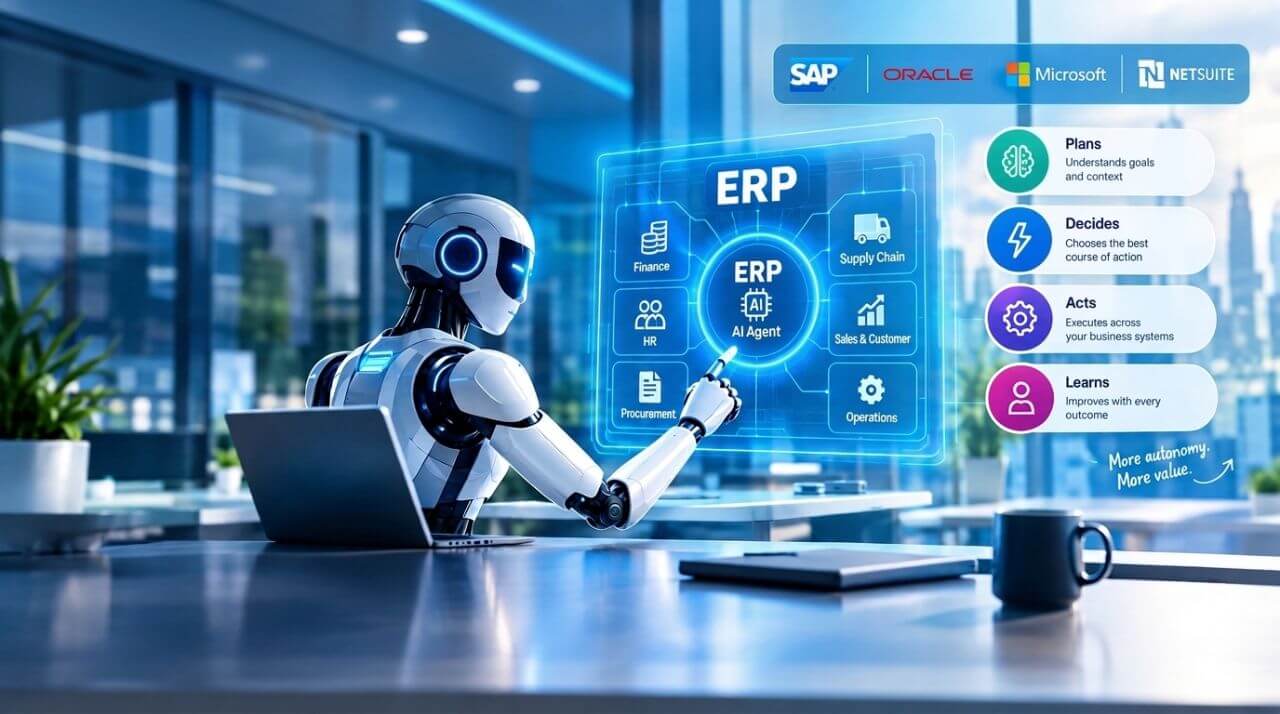
The Paradigm Shift: From Manual Labor to Autonomous Execution
For as long as Enterprise Resource Planning (ERP) has existed, the software has done exactly what you told it to, exactly when you told it to. Traditionally, a human worker has had to open a screen, key in a purchase order, approve an invoice, or close an accounting period. The system merely stores the truth, while people carry out the active work.
That division of labor is transforming at a rapid pace in 2026. This is not happening incrementally, but rather at a speed that makes "ERP as an AI agent" a natural evolution of where the technology trajectory was always heading.
2026: The Year the Copilot Became an Agent
The distinction between a copilot and an agent is critical:
The Copilot Role: A copilot answers a question, drafts a message, or suggests a value, leaving a human to still perform the actual action.
Agent Role: Given an objective, an agent independently plans a sequence of steps and executes them directly against the live business data, typically under defined approval thresholds for consequential tasks.
This transition accelerated drastically over a few short months in 2026:
SAP & Microsoft Integration: In January 2026, SAP merged its AI assistant, Joule, with Microsoft Copilot. This allows project managers in a Microsoft Teams meeting to ask natural-language questions and retrieve live inventory data straight from SAP without changing applications.
Oracle's Rapid Release: Two months later, Oracle introduced roughly twenty new agent-based applications spanning finance, HR, supply chain, and customer service. This was built directly on top of its pre-packaged AI Agent Studio.
Microsoft Dynamics 365: Microsoft expanded Copilot Studio from a simple chat assistant into a closer approximation of an autonomous operator inside Dynamics 365.
Market Adoption: Industry analysts note that task-specific AI agents are projected to sit inside 40% of enterprise applications by the end of 2026, skyrocketing from under 5% at the start of 2025.
Why "Some Agents" Becomes "Every ERP Is an Agent"
While agentic AI in ERP is real today, deployments remain somewhat uneven. Most currently sit at the "suggestion" or "human-confirmation" level, where the agent proposes an action and a human approves anything touching money, inventory, or contracts. Full autonomous execution is largely confined to bounded, lower-risk domains like matching invoices to purchase orders, drafting collections reminders, or routing support tickets.
However, three primary forces indicate that this caution will steadily erode:
Reliability in Multi-Step Reasoning:
AI models have drastically improved in multi-step reasoning. The gap between answering a question correctly and executing a ten-step business process without human oversight has closed significantly over the past two years, with no signs of flattening out by 2029.
Rebuilt Enterprise Plumbing:
The hardest part of agentic ERP was never the AI itself; it was exposing decades of complex business logic and data models as safe, callable actions that an agent can invoke without corrupting the system of record. That heavy integration work—including connectors, permission models, and audit trails—is largely completed or well underway across major platforms like SAP, Oracle, and Microsoft.
Relentless Competitive Pressure:
Major vendors are reshaping their strategies entirely around autonomy. SAP focuses its cloud strategy on an "autonomous enterprise" model, while Oracle’s Fusion Agentic Apps strategy relies on vertical integration across its infrastructure and database layers. As industry leaders race toward autonomous execution, being "agent-native" transitions from an optional feature into the core product.
What Changes When the ERP Itself Becomes the Agent
By 2029, the defining question will no longer be whether an ERP features bolted-on AI agents, but whether the ERP was designed agent-first from the ground up. Several major structural changes follow:
The Decline of the Traditional UI:
If an agent can read requests, analyze business conditions, and execute transactions natively, the traditional multi-tab data-entry screen becomes a fallback mechanism primarily reserved for edge cases and audits.
Risk-Tiered Approval Workflows:
Approvals will be structured by design rather than as reactive patches. Low-risk, reversible actions gain full autonomy, while high-risk, hard-to-reverse actions retain strict human checkpoints as a first-class configuration.
A New Skill Set for Implementation Teams:
Implementation work shifts away from connecting screens to databases and toward defining what an agent is permitted to do, and under what specific conditions.
Commoditization of Traditional Modules:
Choosing an ERP in 2029 will matter less about ledger or inventory capabilities—which will largely be commoditized—and more about trusting a vendor's agent layer, governance frameworks, and audit tooling.
The Governance Question Nobody Gets to Skip
Deploying autonomous agents is not without risk. An agent that mistakenly closes a financial period, ships inventory based on flawed stock data, or issues incorrect collections notices creates significant business and legal liabilities. This accountability challenge explains why 2026 deployments keep humans in the loop for high-stakes decisions, and regulatory scrutiny over enterprise autonomous systems will only tighten as transaction volumes shift toward agents.
Ultimately, "every ERP will be an AI agent by 2029" does not mean systems will run entirely unsupervised. Instead, the agent becomes the default actor handling the routine 80% of enterprise transactions, while humans shift into an oversight, approval, and exception-handling role.